Showing posts with label locavore. Show all posts

Sunday, February 28, 2010

Milk

As Baby approached her first birthday, to be honest, I started counting down the days until we could stop breastfeeding. I had set a goal to breastfeed for her first year of life. It was a wonderful experience, especially when she was a sweet little newborn, but by the time she was a year old she was getting wiggly and bound to spring teeth any day (which didn't happen until 18 months, but who could have predicted that?). Plus, the grandparents were all excited for an overnight visit from Baby, and Nick and I started planning a weekend at a bed and breakfast. Baby had already started solid foods by then, of course, but a large portion of her nutritional needs would still be fulfilled with milk. With all of the controversy about milk these days, I began researching what option would be the best for my little girl.

Here's a very brief summary of what I learned about the current problems with cow's milk*. In an effort to make more money, many dairy farmers give their cows the artificial growth hormone rBGH, created by the corporation Monsanto (big surprise). This added hormone is banned in most of Europe and many other parts of the world. It's my understanding that rBGH increases milk production in cows, but because their bodies are often not able to handle the added milk, it can cause mastitis (an infection). To treat the mastitis, cows are given antibiotics, which theoretically pass into our milk and could potentially not be great for our health.

The other controversy related to rBGH is that the added hormones themselves may be bad for our health. Consumer advocate groups theorize that it can be a cause of early puberty in children. However, several studies have disproven this theory, and it seems that the rise in early puberty is more likely related to an increase in childhood obesity. It is, however, possible that rBGH may be linked to cancer in humans.

While much is still unknown, I decided that it was important to find a milk clear of rBGH for Baby. My criteria for The Ideal Milk was:
  • rBGH-free
  • Locally produced (for environmental and economic reasons)
  • Affordable
Now, I'm not going to list all of the options for milk available in Colorado Springs, because there are MANY, but I will name a few that I considered:
  • Robinson Dairy: While local and convenient (they deliver to your home), the prices were a bit high for the amount of milk we drink.
  • Organic milk available at the grocery store: Not locally produced and pretty expensive.
  • Raw milk from a local farmer: Although arguably the most healthful option for adults, the American Academy of Pediatrics recommends that babies be fed only pasteurized dairy products. Plus, it's usually VERY expensive.
  • Colorado Proud milk: I shop at King Soopers, and Colorado Proud is the brand name of their cheapest milk. It's usually priced around $1.68 - $2.29 per gallon. Not only is it locally produced (I'm defining "local" as "Colorado" here), but it's rBGH free!
So, surprise, surprise, the least costly option ended up being the best choice for my family.

Now I'm curious: If you choose organic milk for your family, what is your reasoning? Am I missing something?

*I'm sorry, I can't quote sources for you...I think I learned the most from Barbara Kingsolver's "Animal, Vegetable, Miracle", but I also did some internet research, and this was nearly a year ago so I don't remember where I found most of it.

Friday, January 1, 2010

The Fruits of My Labors

It's January, and our North-facing driveway is covered in ice, but we've been eating farmer's market and homegrown tomatoes, peppers, cucumbers, basil, peaches, and apples. This is the time of year when I'm thankful for a long summer of food preservation. When I grab a jar of tomato sauce for a quick dinner, I think about all the August nights I was up past midnight waiting for those jars to seal. As I open another pint of salsa when visitors drop by, I remember trashing my kitchen during nap-time to end up with a few jars cooling on the counter. When pregnancy cravings prompt me to raid our linen closet for a new jar of dill pickles, I am happy to have destroyed my fingernails peeling all that garlic. And when Baby requests more "sauce", it's satisfying to open another quart of sugar-free applesauce for my little angel...even if it meant hours of pressing cooked apples through a food mill.

My desire to learn about home canning was inspired by a friend who stayed with us a couple years ago during a road trip with her family. She brought salsa and jam as a housewarming gift, which struck me as the most thoughtful gesture. It's been nice to have a pantry full for my little family, but even better to have quick gifts on hand. Everyone on my Christmas list ended up with at least two jars of food. A loaf of bread and some jam or apple butter have become quick sympathy and get-well-soon gifts for friends.

I thought I would share two more recipes that have brought the best of summer flavors to my table in the middle of winter. Both are freezer recipes, so you don't need any special equipment to enjoy them next year.

This Pesto Torte has been described as "the best thing I've ever tasted" by multiple people in my life, believe it or not! It's a spread for crackers, the perfect hors d'oeuvre to bring to a party. You basically make an entire round spring-form pan and divide it into slices, wrapping and freezing each individually so that you have eight portions ready for parties throughout the year.


By the way, this blog is one of my favorites: Thy Hand Hath Provided. Her young family grows and preserves most of their own food and buys the rest from local farmers. She posted instructions for roasting and freezing roma tomatoes. They are flavored with olive oil and fresh herbs and end up similar to sun-dried tomatoes. I have a gallon bag of these guys in my freezer and am LOVING them! I have yet to buy a single hard, waxy grocery store tomato all winter (except when I asked Nick to pick up some bananas and he came home with about three pounds of tomatoes instead...???). These roasted tomatoes have found their way into pasta dishes, grilled cheese sandwiches, white pizzas, and casseroles. Yum!


It's a bit cruel to share these recipes now, when tomato season couldn't be further away. Sorry. Just giving you a taste of summer before you have to go shovel your sidewalk again!

Photos courtesy of Thy Hand Hath Provided.

Sunday, September 27, 2009

Apples Galore

On Saturday, we made a trip down to Penrose (about 90 minutes from our home) to visit Third Street Apples, a pick-your-own orchard. We had a great day!

We picked Jonathan's, Golden Delicious, Jonalicious, Mcintosh, Seek-no-Further, and one tree labeled "Mystery Apple" :). The owners encouraged us to sample the apples; here's a shot of a cranky Baby chomping on what we thought was a small bite!

Baby got a chance to crawl freely amongst the trees while Nick and I picked apples.

We couldn't pass up the fresh apple cider and apple butter for sale in their gift shop.


When we got home, I made a batch of applesauce with Jonathan's. It turned out pink because I included the skins. Soooo yummy! We still have tons of apples left so hopefully we'll get enough applesauce to last us...a month? If we exercise restraint, that is.

I clipped this recipe out of the Gazette a couple weeks ago (9/16/09) and couldn't wait to try it for dinner tonight. I didn't take a picture, but it turned out beautifully and would make a nice breakfast for company.

The Ruby's Dutch Apple Pancake
(from The Ruby of Crested Butte Bed and Breakfast)

5 large eggs
2 teaspoons vanilla extract
1/2 cup plus 1 tablespoon granulated sugar, divided
1 cup all-purpose flour
1 teaspoon baking powder
1/2 teaspoon fine sea salt
1 1/2 tablespoons unsalted butter
2 large, tart apples, peeled, cored, and cut into 1/2-inch wedges
1 teaspoon ground cinnamon
1 tablespoon confectioners' sugar

1. Preheat oven to 375 degrees.
2. In blender, combine eggs, vanilla, and 1/2 cup granulated sugar and blend until combined, about 5 seconds. Add flour, baking powder, and salt and mix until smooth, about 10 seconds.
3. To 10-inch ovenproof, nonstick frying pan over medium heat, add butter. When butter hhas foamed and foam has subsided, add apples and saute, stirring occasionally, until softened, 4-5 minutes. Sprinkle apples with cinnamon and remaining sugar. Stir together and saute until apples are glazed and edges are slightly translucent, about 2 minutes longer.
4. Spread apples evenly in frying pan and pour batter slowly over top, so apples stay in place. Reduce heat to medium-low and cook until bottom and sides are starting to firm up, about 8 minutes. Transfer to oven and cook until top of pancake is firm and golden brown, about 10 minutes longer. Remove from oven, invert pan over serving plate. Cut pancake into 6-8 wedges. Sprinkle each portion with confectioners' sugar.

Happy apple season!

Thursday, September 10, 2009

Chimichurri Sauce and the Old Stone Church

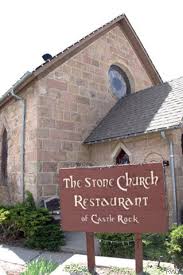
First things first: Have I ever mentioned my favorite restaurant, the Old Stone Church? Located in Castle Rock, it's nearly halfway between Colorado Springs and Littleton, where my parents live, so we occasionally meet for lunch when a granddaughter visit is required. The restaurant is located inside a renovated church built in 1888; not only can you request the booth in the old confessional, but the atmosphere is quite elegant and quaint with stained glass windows and a bubbling fountain inside.


We've only been for lunch, as the entree prices are $8-12 versus $18-25 per plate for dinner. My favorite menu items include the Crab Cakes with Anaheim chile cream and angel hair pasta or the Brie cheese, grilled and served with roasted garlic, blackberry jalapeno chutney and flatbread. Nick usually goes for the flautas (crispy flour tortillas filled with grilled chicken and mild jalapeno salsa) or the traditional fish and chips with amber beer batter and jalapeno tartar sauce. I've tried half a dozen other menu items that were absolutely perfect. Don't get me started on the desserts - the bananas foster or white chocolate bread pudding are nearly impossible to share.

Perhaps the best part of the meal is the grilled flatbread served with bright green chimichurri sauce brought to your table as soon as you sit down. Chimichurri is a traditional Argentinian barbecue sauce made with fresh herbs, olive oil, and vinegar. While gauchos may have originally served it atop grilled steaks, the flavors can brighten up a variety of dishes, including pasta, bean salads, grilled chicken, fish, or vegetables, or a simple dipping sauce for bread.

Each batch turned out a different shade of green, but they all taste delicious!

Since my garden is overflowing with fresh basil, I decided to make a huge batch of chimichurri sauce this week. I froze most of it in Ball's freezer jam containers and reserved a bit to freeze in ice cube trays for use whenever we just need individual servings for bread dipping with dinner. If you are a guest at my house this winter, chances are you will be served beautiful, fragrant chimichurri sauce with some home-baked bread; that is, unless we eat it all first!

Monday, September 7, 2009

Tomato Time


I thought I'd pass along a few more recipes for the home canners out there!


This is my second year making this recipe, and it is much more flavorful than store-bought salsa. Last year, I made 14 pints, which lasted, oh, about a month (I set aside 10 for Christmas gifts). I really want to make enough this summer to keep us swimming in all the salsa we can eat for the next year. So far, I've made 16 pints, but only 13 remain after eating and gifting a few already. Salsa is SOOO much work, but hopefully I get my act together to make some more this month!


I discovered this recipe in Barbara Kingsolver's book Animal Vegetable Miracle. It's quite tasty, but I'm not sure if it's cost effective to make tomato sauce. For some reason, whenever I can anything with tomatoes, it only makes about half as much as the recipe promises. My 7 pints ended up costing about $4.50 each (plus the cost of jars, which I re-used from last year). You can easily buy a 28-ounce jar of tomato sauce for about $2.50, so homemade ends up being quite a bit more expensive (although I don't know the cost of a jar of organic tomato sauce, which would be more comparable).


I'm just glad to have some barbecue sauce in my pantry whose #1 ingredient isn't High Fructose Corn Syrup! I've canned 15 jars, 12 ounces each, and may even make more so that I have plenty for Christmas gifts. I served some roasted chicken with this BBQ sauce on it for dinner the other night; it's delicious!

Wednesday, August 26, 2009

Too Many Pickles?

In my quest to eat locally, I am starting to go a bit overboard with the home canning. So far this year I have canned strawberry-rhubarb jam, blackberry jam, banana pepper relish, salsa, and now...more pickles than we could ever eat.

Ranch Foods Direct (2901 N. El Paso St., Colorado Springs) hosted a free pickling class on Saturday taught by Rachel Zimmerman. Rachel was the youngest of 10 children, and one of her earliest memories is sitting on a stool as a toddler, entrusted with the responsibility of placing the peach halves into the bottom of gallon jars; her little hands were the only ones that fit. In class, we made a batch of dill pickles, and I was eager to volunteer as her assistant so I could get hands-on experience.

Her recipe comes from a vintage Kerr canning book, no longer in print.

Dill Pickles - Fresh Kosher Style

36 to 36 cucumbers, 3-4 inches long
3 cups vinegar
3 cups water
6 tablespoons pickling salt
Fresh or dried dill
Garlic
Mustard Seed

Wash the cucumbers. Make a brine of the vinegar, water and salt. Bring to boil. Place a generous layer of dill, 1/2 to 1 clove of garlic (sliced) and 1/2 tablespoon of mustard seed in bottom of each clean quart jar. Pack the cucumbers into the jars. When the jars are half filled with cucumbers add another layer of dill and complete the packing of the jars. Fill the jars to within 1/2 inch of the top with the boiling brine. Put cap on jars, screwing the band firmly tight. Process 15 minutes* in boiling water bath. Pickles will shrivel some after processing. They will later plump in sealed jar.

*Add 1 minute processing time for each 1000 feet elevation above 1000 feet. For Colorado Springs residents, this would be 21 minutes processing time.

Rachel showed us a couple of variations to this recipe. You can add a layer of cherry or grape leaves in the top of the jar to add crispness (that's right, just go pluck a few leaves off your cherry tree or grape vine). Another option is to add some sliced fresh ginger root for a spicier flavor. I did both of these variations in my pickles.

This is only one of the boxes of cucumbers, washed and ready to go with a bowl of fresh dill.

Now, you may be wondering why I made so many pickles for a small family of 3. First of all, I had no idea how many cucumbers were in each 25 pound box being sold at the farmers' market. I went up to one stand, and they were selling the most beautiful, small cucumbers for $20/box. The neighboring farmer may have overheard our conversation because when I approached, she said they were selling cucumbers for $20 as well but she would give me a box for $15. I paid for my cukes before realizing that this farm stand was selling larger ones, and I really wanted small ones so I could can them whole. Too embarassed to "return" my produce, I went back to the first stand and bought another box. I thought, maybe I'll get a couple dozen quarts out of this and I'll have enough for Christmas stocking stuffers. A whopping 38 quarts later, I still had half a box to go...I called my neighbor and begged her to take them off my hands. I didn't care if she threw them away, as long as they were out of my sight! (She made bread and butter pickles).

These are a bit shriveled and will plump up later.

Thanks, mom, for coming to help out when I realized I was in over my head! Poor Baby would have been rather neglected otherwise. I can't taste the pickles for 6-8 weeks, so let's just hope that they're delicious...or I'll have a bunch of unlucky Christmas gift recipients!

Since this is my first year doing pickles, the start-up costs are a bit higher than they'll likely be next year (for example, I will not have to buy the jars again, only lids). Also, I'm including the cost of all 50 pounds of cucumbers even though I only used about 37 pounds.

  • 38 new wide-mouth quart jars (on sale for $11/12 jars): $34.83
  • Cucumbers (50 pounds): $35.00
  • Pickling Salt: $1.29
  • Fresh dill ($2 each, 3 bunches): $6.00
  • Apple Cider Vinegar ($4.39 each, 2 gallons): $8.78
  • Mustard Seed (estimated, I lost the reciept): $5.00
  • Fresh ginger root ($3.99/lb, 0.5 pounds): $2.00
  • Garlic (homegrown): FREE
  • Cherry leaves (homegrown): FREE
Total cost per quart: $2.44

I believe that store-bought pickles are about $3 -$4 for a 24-ounce jar. The lowest sale price that I've seen for pickle spears is $2.50 each. Since a quart jar is 32 ounces, that would cost approximately $3.33 per quart. So, I saved a little bit of money and now have a year's supply of locally grown, mostly organic pickles (I did not buy organic vinegar or mustard seed). Next year, I'll save even more when I recycle those canning jars. Maybe it was worth it to completely trash my kitchen for a day?

Saturday, August 22, 2009

Farmers' Market Find: Basil and Purple Potatoes

I forgot to mention the best finds from the farmers' market this week! Here ya go:

I've been waiting all summer for some decent basil. I refuse to buy the little $3 plastic container of 5 shrimpy basil leaves at King Soopers. Last year, I came home from the very last day of the summer's farmers' markets with two HUGE bunches of fresh basil. They were gorgeous! I left them in the fridge for a weekend away, intending to make pesto when I got home, only to come back to a brown slimy mess. I read that basil and other fresh herbs are in season in August in Colorado Springs, so I've been scouring every market stand for the last few weeks. One farmer mentioned that all of his basil was destroyed by hail this year. Finally, this week, one stand had some beautiful basil. I bought two bunches ($2 each) and stocked my freezer with some bright green pesto. If you read as many cooking magazines as I do, you already know to freeze pesto in ice cube trays, then pop the cubes out into freezer bags so you can remove as much or as little as you'd like throughout the winter.


Have you ever had a purple potato? I hadn't! Maybe it was blue. Whatever the color, it was definitely tasty! I bought a basket of six large potatoes (russet potato size) for $3. I was surprised to find that the inside is just as colorful as the skin! Barbara Kingsolver's Animal, Vegetable Miracle mentions that these blue potatoes contain the same antioxidants that give blueberries their claim to fame as a Superfood in addition to the typical potassium and whatnot found in a regular potato.

I made my mom's "Tortilla de Patatas" recipe from her time living in Spain. It's not an exact science: dice one large potato, cook it in vegetable oil in an 8" skillet, then drain off the oil. Crack 6 eggs into a bowl, stir with a fork, then add the potato and some salt and stir. Pour it all back into your skillet and cook until done (like a frittata). Baby is eating her third serving as I type this! Thanks for the recipe, mom!

Thursday, August 20, 2009

Farmers' Market Challenges

You know how I'm trying to shop locally as much as I can, visiting farmers' markets every week? Well, it can be a bit overwhelming elbowing my way through the crowded market, balancing boxes of tomatoes on top of the baby stroller, making quick purchasing decisions. I've made some mistakes, so I thought I'd pass on a few tips I've learned in case it's helpful to anyone:
  • Not all produce sold at a farmers' market is locally grown. Sure, some markets (in other cites, and I believe the Tejon market in the Springs) have regulations requiring all products to be locally grown and possibly organic, but every market I've been to in Colorado Springs has had no such rules. Most stands have a variety of produce with signs indicating whether it's "homegrown" or from Colorado (or a specific region, such as Pueblo or Rocky Ford). If the sign doesn't specifically indicate its origin, then you can bet it's from California or further. One exception is if the stand has a large sign showing the name and location of the farm, with the assumption that every item sold there is homegrown.
  • Don't be afraid to inspect the produce. Last week, I was excited to find Rocky Ford cantaloupes for $1 at one stand, while every other stand charged $1.50-$2. I paid a couple bucks and then went to choose my melons, only to find that every single one had soft spots; obviously, this was an assortment of "seconds". Many stands sell "seconds" for cheaper than perfect produce, but do not indicate why it is cheaper on their signs.
  • Along those same lines, don't assume that there will be any consistency from week to week. Last week, I bought a 20 pound box of the most beautiful tomatoes I've ever seen for $15. Well, I botched the tomato sauce I tried to make, so I went straight back to that stand today to buy another box. Today, I discovered after buying them that the tomatoes were not quite ripe and not nearly as perfect. They'll still work, but I may have shopped around more at the other stands if I had taken the time to inspect the tomatoes before paying. I was too chicken to try to return them, too.
Does anyone else have tips about finding good deals at farmers' markets? Or a favorite market in Colorado Springs? I would love to hear it.

Saturday, August 8, 2009

Locavore Aspirations

I realize that half of this post is in black text and that November was left off the chart, and I'm sorry, but it's past my bedtime and I'm not a perfectionist!

Starting a couple weeks ago, my grocery shopping errand became a bit more pleasant. I've been able to completely skip the produce department. No, my garden is not quite providing our family with all of our vegetables (nor will it ever). And no, I'm not raising Baby as a carnivore. Instead, I've been shopping with more of a "locavore" attitude: trying to find local sources for some of our food. It turns out that fresh produce is a great place to start. Look at how plentiful the month of August is in Colorado Springs:

Crop Calendar
Chart courtesy of the Colorado Farm and Art Market website.

I've been reading Animal, Vegetable, Miracle by Barbara Kingsolver and am feeling inspired to seek out locally grown foods. Those winter fauxmatoes at the grocery store with their hard, pink flesh don't even compare to a fresh red tomatoes picked off the vine this morning. I'm starting to reconnect with the seasons; it sounds obvious, but it's easy to forget that strawberries need to travel quite a distance to arrive in Colorado in January.

Anyway, this is a roundabout way of getting to my point; I've been visiting the farmers' markets every week and I'd love to pass on the treasures I find to you. Maybe I'll share a recipe I've tried using local, seasonal ingredients. I'll pass along the recipes I use for home preserved treats like salsa, jams, and pasta sauce. Or I might just feature a couple of really great deals I found that week. I hope to encourage other Colorado Springs folks to support our local farmers by buying some produce directly. Here is a schedule published by the Gazette.

MONDAYS
•
Homegrown on Tejon
10 a.m.-1 p.m., June 15-Oct. 12
300 block of North Tejon Street
636-2852
•
Memorial Park
7 a.m.-1 p.m., June 22-Oct. 5.
Pikes Peak Avenue and Union Boulevard
574-1283

TUESDAYS
•
Fountain Farmers Market
3-7 p.m., June 16-Sept. 29
City Hall, Ohio and Main Streets
447-8637

WEDNESDAYS
•
Colorado Farm & Art Market
3-7 p.m., June 10-Oct. 7.
America the Beautiful Park, 126 Cimino Drive
farmandartmarket.com, 640-6154
•
Manitou Springs Midweek
4-8 p.m., June 10-Aug. 26.
Soda Springs Park, 1000 Manitou Ave., Manitou Springs
80829.com, 358-7845
•
Monument
Noon-6 p.m. June 10-Oct. 14.
Sundance Mountain Lodge, 1865 Woodmoor Drive
213-3323

THURSDAYS
•
Memorial Park
7 a.m.-1 p.m., June 22-Oct. 5.
Corner of Pikes Peak Avenue and Union Boulevard
574-1283

FRIDAYS
•
Woodland Park
7 a.m.-1 p.m., June 12-Sept. 25.
The corner of Center and Henrietta streets
woodlandparkfarmersmarket .com, 687-9053 or 689-3133

SATURDAYS
•
Colorado Farm & Art Market
9 a.m.-1 p.m., June 13-Oct. 10.
The Margarita at PineCreek, 7350 Pine Creek Road
farmandartmarket.com, 640-6154
•
Doherty High School
7 a.m. to 1 p.m., June 27-Oct. 3
4515 Barnes Road
574-1283
•
Monument
8 a.m.-1 p.m., June 6-Oct. 10.
481 Colorado 105 (behind Starbucks)
213-3323
•
Old Colorado City
7 a.m.-1:30 p.m., June 6-Oct. 31.
24th Street and West Colorado Avenue
574-1283
•
Briargate
8 a.m.-noon, June 13-Sept. 26.
Briargate Parkway and Chapel Hills Drive (Salsa Brava parking lot)
210-9229, briargatefarmersmarket.com
•
Heritage Farmers' Market
9 a.m.-11:30 a.m. June 13-Sept. 26
East parking lot at Cheyenne Mountain Junior High School
1200 W. Cheyenne Mountain Road
632-7000

SUNDAYS
•
Palmer Lake
10 a.m.- 2 p.m., July 5-Oct. 11
On the lake at the gazebo in Palmer Lake 213-3323

Last week, I came home with a variety of veggies but was really impressed by the Torpedo Pepper Sausage from Torpedo Farms in Pueblo. I grilled them to accompany whole wheat hot dog buns one night, and tossed the leftovers in a Cheesy Sausage Pasta Bake the next day.

Today I discovered some Rocky Ford cantaloupes for $1 each along with the ingredients for a (hopefully delicious) banana pepper relish. I'll give it a try and if it's as good as I hope it is, I'll be sure to pass along the recipe.